
Some concrete countertops end up in a kitchen that a handful of people see every day. Others end up on the roof of Fenway Park, where crowds of Red Sox fans lean on them all season long. Michael Paulsen of Stone Soup Concrete has built both, and his shop’s work on the Budweiser bar at Fenway is one of the more memorable commercial projects in the creative concrete world.
Michael has been fabricating concrete for about as long as Jeff Girard has been in the industry, and the two have crossed paths at industry events for years. This story starts at the ballpark, steps back to how Stone Soup got its start, and finishes inside a family’s home, where Michael’s concrete is part of everyday life.
The Budweiser Bar at Fenway Park
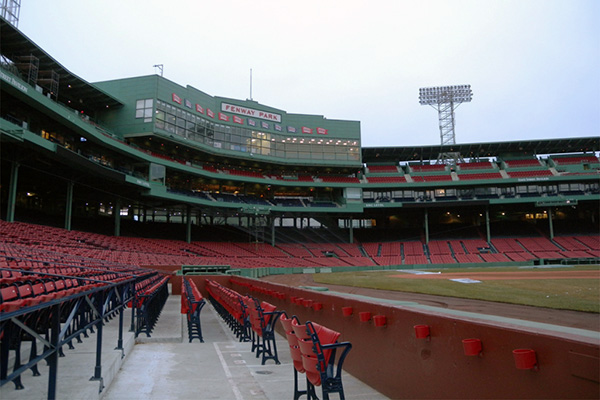
Fenway Park opened in 1912 and is the oldest active ballpark in Major League Baseball. Before the 2004 season, the Red Sox added seating on the right field roof above the grandstand and named it the Budweiser Right Field Roof Deck (it was renamed the Sam Deck in 2018). The deck is known for its big bar, and Stone Soup Concrete made the concrete tops for it.
The finished bar sits on a red brick base painted with Budweiser’s crowned “B” logo, and the tops are a dark charcoal concrete with a polished, glassy surface. In the afternoon light, the tap towers reflect in the concrete almost the way they would in still water, and the long run of tops turns a corner to follow the shape of the covered deck. The dark color sits comfortably against the park’s green steel and old red brick, so the bar looks like it has always been part of Fenway rather than something added to it.
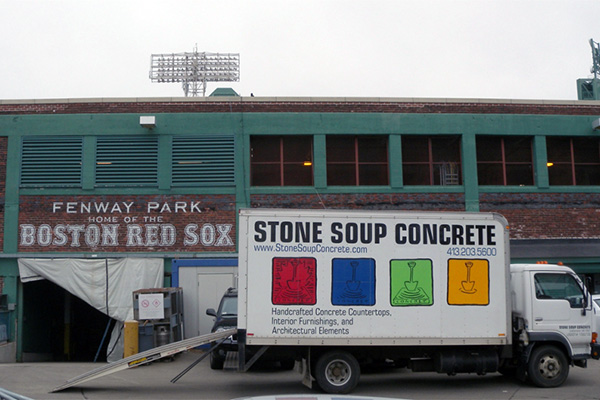
The installation photos tell their own story. Stone Soup’s box truck is parked against Fenway’s “Home of the Boston Red Sox” wall. Up on the roof, each top waits on a wheeled A-frame cart, strapped and braced with wood blocking and padded where it touches, with the cutouts for the taps already in place. In one shot, a Stone Soup crew member stands next to a finished top with the empty grandstand and the Coca-Cola sign behind him.
The lesson for any fabricator here is planning. Every piece had to be cast, finished, loaded, trucked into the city, and rolled across a rooftop to the exact spot it was built for. The dimensions and cutouts had to be right before anything left the shop, because there is no good way to fix a mistake on the roof of a ballpark built in 1912.


How Stone Soup Concrete Began
Stone Soup didn’t start as a concrete company. Before concrete, Michael worked in construction, where his company also served as a proving ground for his patented Task tool belt system. He had a strong interest in materials and took on complicated work that included rebuilding damaged church steeples. Steeple work meant long days high up on ladders, and as the story goes, Michael’s wife encouraged him to come back down to the ground. Concrete, with all of its history as a building material, is where his interest went next.
Stone Soup has been working with customers since 2001. The shop grew up in Massachusetts’ Pioneer Valley, first in Florence and later in the Eastworks building in Easthampton, and by 2007 it had eight full-time employees and served all of New England as well as New York, New Jersey, and parts of Pennsylvania. Over the years the shop’s range has grown from countertops to farm sinks, bathtubs, fireplaces, vanities, furniture, microcement, and what Stone Soup calls formed object art.
Michael’s process is collaborative. Clients send a scaled drawing and their inspiration, Stone Soup asks detailed questions, and the design gets refined down to small but thoughtful choices, such as slightly rounding a corner where a room’s entry is tight. Large pieces require quite a bit of thought too, especially when it comes to installation.


A Home Built Around Concrete
Fenway shows what Stone Soup can do in front of a crowd, but some of Michael’s most impressive work lives in private homes. One of them is a large coastal house in Nantucket. Concrete runs through nearly every space the family gathers in, from the kitchen out to the deck.
The main kitchen island wraps down to the floor with waterfall ends, and a thin dark reveal runs just under the top, so the slab appears to float above its base. One end frames a wall oven and warming drawer in concrete, while the other opens into concrete shelving deep enough for serving bowls and cutting boards. A second island seats four on cane stools, with matching waterfall ends and a reveal that echoes the first, and the perimeter counters hold a long stainless trough sink under a wall of windows.
Outside, a long countertop holds a recessed prep station with fitted inserts, including slotted drain grates and round cutouts, set beside twin faucets and a built-in grill. In a sunken lounge on the deck, a low concrete fire table holds two rectangular fire wells filled with smooth stones, surrounded by built-in seating.
Concrete like this is built to be lived on, and keeping it looking its best is part of the job. Stone Soup offers a maintenance program for its older clients, and Michael has told Jeff those visits have been very well received. When this home was due for fresh sealer, Michael resealed the islands, counters, outdoor kitchen, and fire table in a single visit with Ovation. His summary, texted to Jeff afterward, was short and to the point: “Giant reseal visit using your sealant. Cakewalk.”
Ovation suits this kind of work. It’s a single-component, water-based sealer, so there’s no mixing ratio, no induction time, and no pot life to manage while working through a whole house. It cures food safe and is very slightly color enhancing, and with a two-year shelf life, leftover sealer stays usable for future touch-ups. On a job with this many surfaces, that simplicity is what turns a big reseal into the “cakewalk” Michael described.
If you’re setting up maintenance visits for your own clients, or resealing concrete countertops of your own, take a look at Ovation to see how it works and which sheen fits your project.


