
Pozzolans are materials that make concrete stronger, more durable, and more workable – which is why they’re essential in modern concrete countertop mix designs.
But what exactly are pozzolans, and which ones should you use? Let’s break it down.
What Are Pozzolans?
Pozzolans are silicate-based materials that react with the calcium hydroxide generated by hydrating cement to form additional cementitious compounds. In simpler terms: they turn a waste product (lime) into the stuff that actually makes concrete strong.
Pozzolans are silicate-based materials that react with (consume) the calcium hydroxide generated by hydrating cement to form additional cementitious materials. They are often used in concrete countertop mix designs.
How Do Pozzolans Work?
Why is consuming calcium hydroxide a good thing? Calcium hydroxide (lime) accounts for up to 25% of the hydrated Portland cement, and lime does not contribute to the concrete’s strength or durability. Pozzolans combine with the lime to produce additional calcium silicate hydrate, the material responsible for holding concrete together. By consuming the excess lime:
- The strength of the concrete is increased
- Its density is increased
- Efflorescence is decreased
- The propensity for alkali-silica reaction (reaction with glass) is decreased, or even virtually eliminated
Using Pozzolans as Cement Replacements
Typically pozzolans are used as cement replacements rather than cement additions. Adding pozzolans to an existing concrete mix without removing an equivalent amount of cement increases the paste content and decreases the water/cement ratio.
In other words, adding more pozzolans to a mix changes the mix proportions. Replacing some of the cement with pozzolans preserves the mix proportions.
Pozzolans replace cement pound for pound in good concrete countertop mix designs.
Types of Pozzolans
Depending upon the particle size, chemical composition and dosage, different pozzolans will affect the concrete strength differently and at different times during curing.
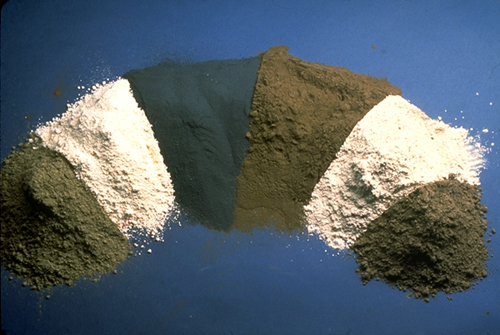 Left to right: Class C fly ash, Metakaolin, Silica Fume, Class F fly ash, Slag, Calcined Shale. From the Portland Cement Association
Typical pozzolans include:
- metakaolin
- silica fume
- fly ash
- slag
- VCAS (vitrified calcium alumino-silicate)
Reactivity of Pozzolans
- Silica fume is the most reactive pozzolan.
- Metakaolin is close to silica fume in terms of reactivity.
- Fly ash is less reactive, especially during the first few days of curing when less calcium hydroxide is generated.
Generally the finer the pozzolan particles are, the more reactive they are.
- Silica fume is the finest with most particles averaging 0.3 µm (microns)
- Metakaolin averages about 4 µm,
- Portland cement averages about 15 µm
- Fly ash averages about 70 µm.
How Pozzolans are Made
Many pozzolans are waste products from industrial processes. As such the color, quality, gradation and properties can vary and are not controlled.
- Fly ash comes from coal-fired power plants.
- Silica fume and slag come from some steel refineries.
VCAS and metakaolin are purposefully manufactured pozzolans. Quality, color and other characteristics can be controlled, so product consistency is greater. There may also be different grades available.
Pozzolan Blends
Most pozzolans are used individually, but blends of two or more different pozzolans can be used to take advantage of the characteristics each pozzolan offers. Typical examples are fly ash and silica fume blends: the fly ash increases workability and particle packing, and the silica fume helps with early strength and total strength development.
However, this is typically not necessary in concrete countertop mixes. I recommend a simple replacement of cement with VCAS.
Why Pozzolans Matter for Concrete Countertops
While pozzolans are used across all concrete applications, they’re particularly important for countertops because:
For Precast Countertops:
- Improved surface finish and fewer pinholes
- Better release from forms
- Reduced efflorescence (white haze)
- Enhanced long-term durability against staining
For GFRC Countertops:
- Better fiber encapsulation in spray mixes
- Improved cohesion for vertical applications
- Enhanced crack resistance in thin sections
- More consistent color in face mixes
The key is choosing the right pozzolan and dosage for your specific casting method.
Choosing Pozzolans for Concrete Countertops
For Professional Fabricators:
VCAS and metakaolin are your best options because:
- Consistent quality – Manufactured products, not waste byproducts
- Color control – White VCAS and off-white metakaolin won’t affect final color
- Reliable performance – No batch-to-batch variation
My Recommendation: VCAS by Vitro Minerals
I specifically recommend VCAS for three reasons:
- White color – Won’t discolor your concrete
- Recycled content – Environmentally responsible (recycled bottle glass)
- Enhanced workability – Actually makes mixes easier to work with (unlike silica fume)
My mix design for Integrity PowerPack includes VCAS as one of the pozzolans.
Dosage of Pozzolan in Concrete Countertop Mix Design
Too little pozzolan and you won’t get the benefits. Too much and you’ll compromise early strength or workability. Here’s what works:
The ideal dose of VCAS for concrete countertop mixes is:
- For precast mixes, 15% cement replacement
- For GFRC mixes, 20% cement replacement
These rates give you the sweet spot of improved performance without negative trade-offs.
Dosage range for all pozzolans:
| Pozzolan | Dosage | Effects |
| Fly ash: Class C | 15% to 40% | Increased workability. Early strength suffers with higher replacement doses |
| Fly ash: Class F | 15% to 25% | Increased workability. Early strength suffers with higher replacement doses |
| Slag | 25% to 50% | Increased workability. Early strength suffers with higher replacement doses |
| Silica fume | 5% to 10% | Significantly decreased workability |
| VCAS | 5% to 25 % | Increased workability |
| Metakaolin | 10% to 15% |
Decreased workability |
Putting This Into Practice
Understanding pozzolans is one thing – using them effectively in your mix designs is another.
Pro Tip: CCI’s PowerPack admixture system includes optimized pozzolanic materials specifically formulated for concrete countertops, eliminating guesswork in proportioning.
→ Learn more about PowerPack
Ready to go deeper?
→ Read: What is the Best Concrete Countertop Mix? – Learn more about the performance requirements of concrete countertop mixes
→ Watch: How to Make GFRC: A Step by Step Process (with Mix Design) – Free training on GFRC
→ Explore: Professional GFRC Training Workshops – Master advanced mix design in person
Additional References for Information about Pozzolans
- www.cement.org/cement-concrete/concrete-materials/supplementary-cementing-materials
- www.concrete.org/tools/frequentlyaskedquestions.aspx?faqid=688
- www.concrete.org/tools/frequentlyaskedquestions.aspx?faqid=689
- en.wikipedia.org/wiki/Pozzolana
- precast.org/2017/03/scms-in-concrete/?fs=pozzolan
- precast.org/2020/01/a-closer-look-fly-ash-slag-cement-metakaolin/?fs=pozzolan
- precast.org/2022/04/ground-glass-pozzolans-a-new-supplementary-cementitious-material/?fs=pozzolan