
If you’ve been researching concrete for countertops, furniture, panels, or other decorative work, you’ve almost certainly run into the term UHPC. It’s everywhere in the artisan concrete world right now – but most of the information you’ll find online is about bridges and infrastructure, not the kind of work you’re actually trying to do.
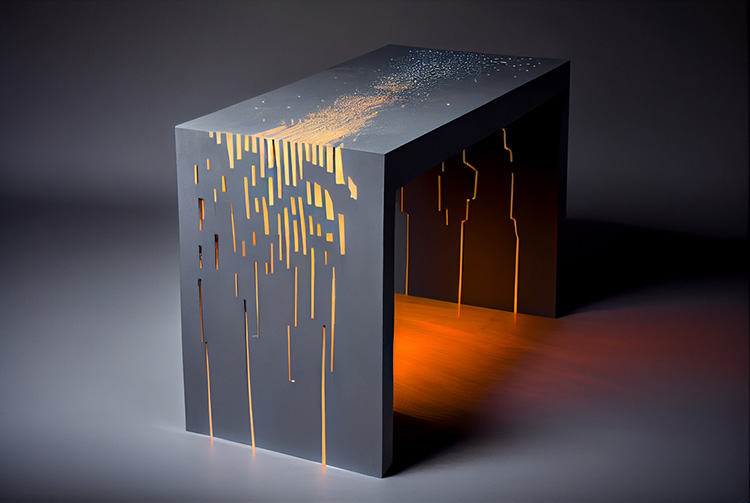
Concrete furniture by Mark Rowney of Woven Stone in England, CCI alumnus
This article is different. We’ll cover what UHPC really means according to industry standards, but more importantly, we’ll explain how it relates to decorative and artisan concrete work, how it compares to GFRC and ECC, and what you actually need to know to make informed decisions about materials and mix design for your projects.
What Is Ultra High Performance Concrete?
UHPC stands for Ultra High Performance Concrete. It’s not a single recipe – it’s a classification of cementitious materials whose mechanical and durability properties far exceed those of conventional or even high-performance concretes. That includes low permeability, very high compressive strength, and sustained post-cracking tensile resistance.
According to the American Concrete Institute (ACI), the concrete industry generally defines UHPC as having 28-day compressive strengths greater than 17,000 psi (117 MPa). To put that in context, standard concrete used in residential construction typically has a compressive strength of around 2,500 to 5,000 psi. UHPC starts at more than three times the top of that range.
The National Precast Concrete Association (NPCA) describes UHPC as a range of formulations used across both architectural and structural applications:
- Structural UHPC, which usually incorporates high-carbon metallic fibers, can achieve compressive strengths up to 29,000 psi (200 MPa) and flexural strengths up to 2,900 psi (20 MPa).
- Architectural UHPC, which typically uses Polyvinyl Alcohol (PVA) fibers, can achieve compressive strengths up to 17,000 psi (117 MPa) and similar flexural strengths.
What makes UHPC different from conventional concrete isn’t just one property – it’s a carefully engineered combination of factors: fine aggregates (no coarse aggregate), a balanced blend of portland cement and pozzolans such as silica fume or slag, a very low water-to-cementitious ratio, maximized particle packing, and appropriate fiber type and loading.
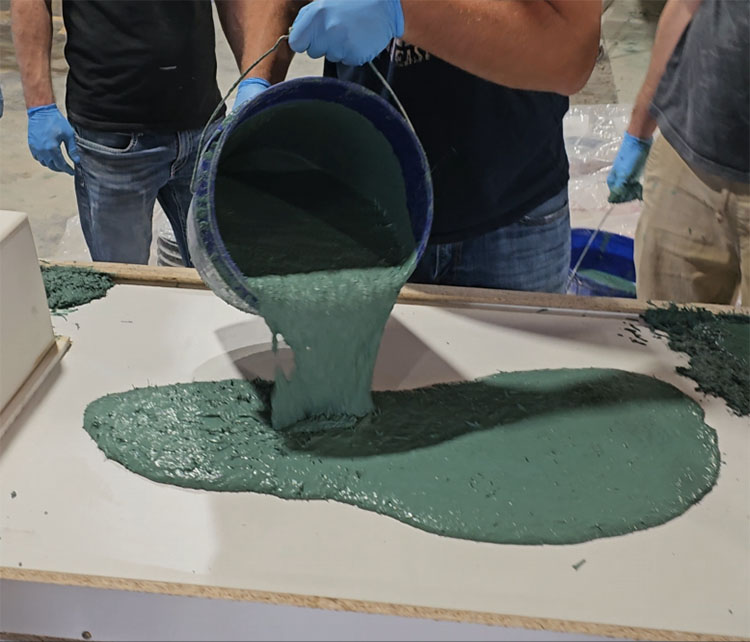
The result is a mortar-like material that flows with minimal agitation – similar to self-consolidating or even self-leveling concrete – while delivering exceptional cured strengths. Fabricators typically cure UHPC either through continuous moist curing or steam curing.
What Is the Difference Between UHPC and Normal Concrete?
The differences between UHPC and normal concrete go well beyond just strength numbers. They’re fundamentally different materials in terms of design philosophy, ingredients, and performance.
Ingredients and mix design. Normal concrete uses coarse aggregates (gravel or crushed stone), portland cement, water, and sometimes basic admixtures. UHPC eliminates coarse aggregate entirely, using only fine aggregates combined with a carefully optimized blend of cement and supplementary cementitious materials like silica fume and slag. Every component in a UHPC mix is selected to maximize particle packing – filling the gaps between particles at every scale to create the densest possible matrix.
Water content. Normal concrete typically has a water-to-cement ratio of 0.40 to 0.60 or higher. UHPC uses extremely low water-to-cement ratios, often below 0.25. Less water means fewer capillary pores in the cured material, which is what gives UHPC its remarkable durability and impermeability.
Fiber reinforcement. Normal concrete is brittle. When it cracks, it fails. UHPC incorporates fibers – metallic, PVA, or other types depending on the application – that bridge cracks and provide sustained post-cracking tensile strength. This is what gives UHPC its ductility and toughness.
Strength. Normal concrete ranges from 2,500 to 5,000 psi in most residential and commercial applications. High-performance concrete might reach 8,000 to 14,000 psi. UHPC starts at 17,000 psi and can exceed 29,000 psi.
Durability. Because of its extremely dense matrix and low permeability, UHPC resists freeze/thaw damage, chemical attack, and moisture infiltration far better than conventional concrete. UHPC has demonstrated 100% retention of material properties after 600 freeze/thaw cycles, and its chloride permeability is less than 10% that of normal concrete. This translates to dramatically longer service life in demanding environments.
Complexity. Normal concrete is relatively forgiving – you can vary proportions and still get an acceptable result. UHPC demands precision. The particle packing, water content, mixing procedures, and curing all need to be carefully controlled to achieve the target performance.
-

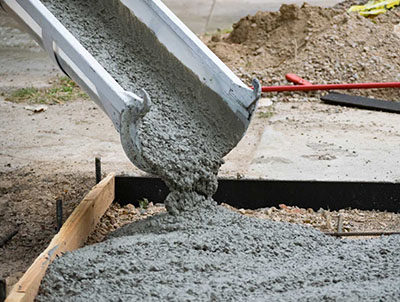
- Pouring conventional concrete
-
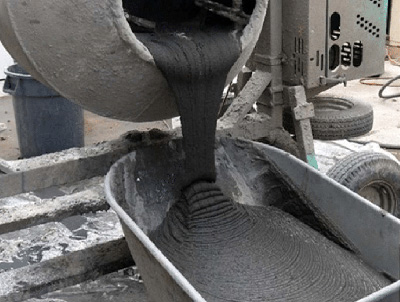
- Pouring UHPC
What Is UHPC Used For?
Most of what you’ll read about UHPC focuses on infrastructure – and for good reason. Its combination of extreme strength, durability, and low permeability has made it increasingly popular for bridge construction, bridge deck overlays, structural connections, seismic retrofits, and infrastructure repair. Transportation departments across the U.S. have adopted UHPC for bridge joints and connections, and it’s used in infrastructure projects worldwide.
But infrastructure is only part of the UHPC story. Here’s where it gets relevant for a broader audience:
Architectural facades and panels. Architectural UHPC allows designers to create thin, intricate facade panels that would be impossible with conventional concrete. Its flowability means it can fill complex mold geometries while its strength allows for very thin cross-sections.
Decorative and artisan concrete. This is where things get interesting – and where the most confusion lives. In the countertop, furniture, and decorative concrete world, “UHPC” has become a widely used term. But what artisan makers mean by “UHPC” and what the engineering world means are often quite different things. We’ll dig into that distinction below, because it has real implications for your work.
UHPC for Countertops and Decorative Work: What You Actually Need to Know
If you’re here because you want to make concrete countertops, furniture, sinks, fire features, or other decorative pieces – this section is for you.
In the artisan concrete community, “UHPC” has become a catch-all term for any highly flowable, high-strength concrete mix that uses fine aggregates, cement/pozzolan blends, low water-to-cement ratios, and fiber reinforcement. These mixes share characteristics with true UHPC, and many of them produce excellent results for decorative applications.
However, few artisan mixes actually meet the 17,000+ psi compressive strength threshold that defines UHPC in the engineering world. That doesn’t make them bad mixes – for countertops and decorative work, you rarely need compressive strengths anywhere near that level. It just means people are using the terminology loosely, and that matters when you’re trying to learn and make good decisions about materials.
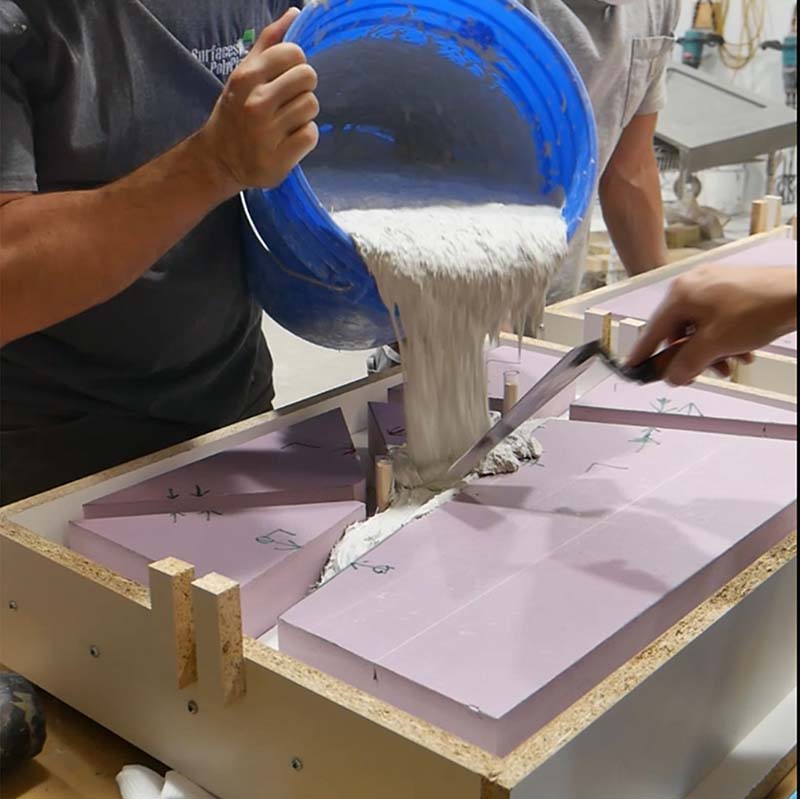
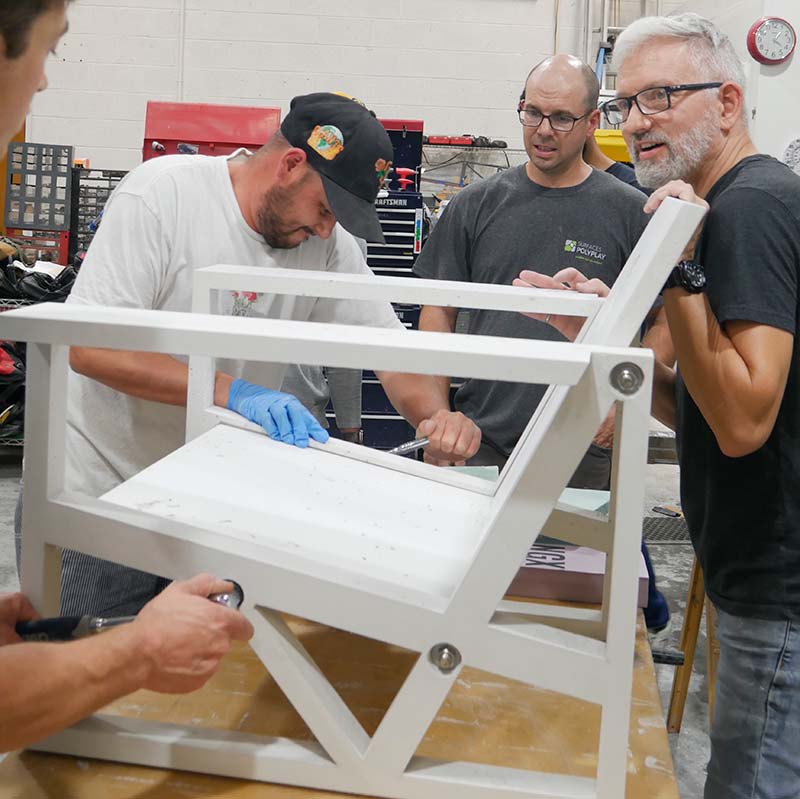
The Questions Most People Have
Having worked with thousands of concrete countertop makers, we know the questions that come up most often when people start exploring UHPC for decorative work:
“Where do I buy premixed UHPC, and should I?” You can buy premixed UHPC bags – just-add-water products that simplify the process. They can be a convenient starting point for testing and experimentation. But convenience comes with trade-offs. You can’t adjust the mix to suit specific project requirements, and you’re paying a premium for pre-blended ingredients. When you understand the engineering principles behind high-performance concrete, you gain the ability to design and adjust mixes tailored to your specific applications.
“Can you give me the exact formula and water-to-cement ratio?” There is no single UHPC formula. UHPC is a classification, not a recipe. Mix designs vary based on the specific materials available, the application, the casting method, and the performance targets. A formula that works perfectly with one brand of cement and one source of silica fume may not work at all with different materials. This is why understanding principles matters more than memorizing a single recipe. When you understand how particle packing, water demand, fiber loading, and pozzolanic reactions work, you can design and troubleshoot mixes rather than blindly following a formula.
“I want to experiment but I wouldn’t even know how to mix it.” This is more common than you’d think, and it’s completely understandable. The terminology and technical specs can be intimidating. The good news is that you don’t necessarily need to start with UHPC. For most decorative concrete applications, GFRC (Glass Fiber Reinforced Concrete) gives you excellent results with a more forgiving, more approachable process – and the skills and principles transfer directly. More on that below.
“How does it handle expansion and contraction? Does it crack?” All concrete expands and contracts with temperature changes. UHPC’s extremely dense matrix and fiber reinforcement make it more resistant to cracking than normal concrete, but it isn’t immune to thermal movement. For decorative applications like countertops, the smaller scale of the pieces means thermal movement is much less of a concern than it is for large slabs or infrastructure. Proper mix design, casting technique, and curing are what determine whether your finished piece performs well – regardless of whether you call the material UHPC or something else.
What Is GFRC and Why Does It Matter If You’re Interested in UHPC?
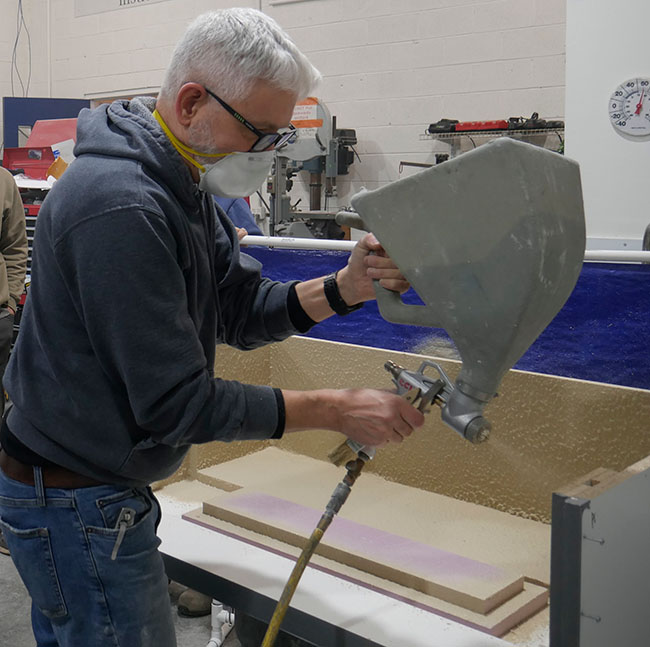
GFRC stands for Glass Fiber Reinforced Concrete. It’s a composite of cement, fine aggregates, polymers, water, and alkali-resistant (AR) glass fibers. The glass fibers transform concrete into a lightweight, ductile, and highly durable material – ideal for thin, lightweight castings including countertops, architectural panels, facades, furniture, and other decorative elements.
If you came to this page looking for UHPC information for decorative or artisan work, GFRC deserves your serious attention. Here’s why:
The overlap is bigger than most people realize. GFRC is traditionally sprayed or hand-applied in layers. But GFRC can also be formulated to be highly flowable and cast directly into molds – and when you do that, the line between “GFRC” and what the artisan world calls “UHPC” gets very blurry. Both use fine aggregates, cement/pozzolan blends, and fiber reinforcement. Both can achieve excellent flowability.
Why Choose GFRC?
GFRC is optimized for what decorative work actually demands. For countertops and decorative pieces, flexural strength – how well the material resists bending and breaking – matters more than compressive strength. GFRC specifically targets maximum flexural performance. You don’t need 17,000 psi compressive strength for a kitchen countertop. You need a material that’s lightweight, strong in flexure, durable, and practical to fabricate. That’s GFRC.
GFRC is more forgiving and practical. GFRC uses a relatively uniform sand size and is more tolerant of variations in ingredient proportions and sizes than UHPC. Materials are easier to source. And you can demold GFRC made with polymer meeting international requirements for curing admixtures after just 24 hours and air-cure from there – no steam curing or extended moist curing required.
The skills transfer. The mix design principles, casting techniques, and material science you learn working with GFRC form a direct foundation for working with any high-performance cementitious material, including true UHPC formulations. You’re not choosing a lesser material – you’re choosing the right material for the application while building knowledge that applies broadly.
For more about GFRC, see our free training about GFRC.
What Is ECC?
ECC stands for Engineered Cementitious Composite. It’s an advanced fiber-reinforced concrete developed to enhance tensile strength, ductility, crack resistance, and long-term durability. ECC can be traced back to the theory that Professor Victor Li of the University of Michigan proposed in 1992.
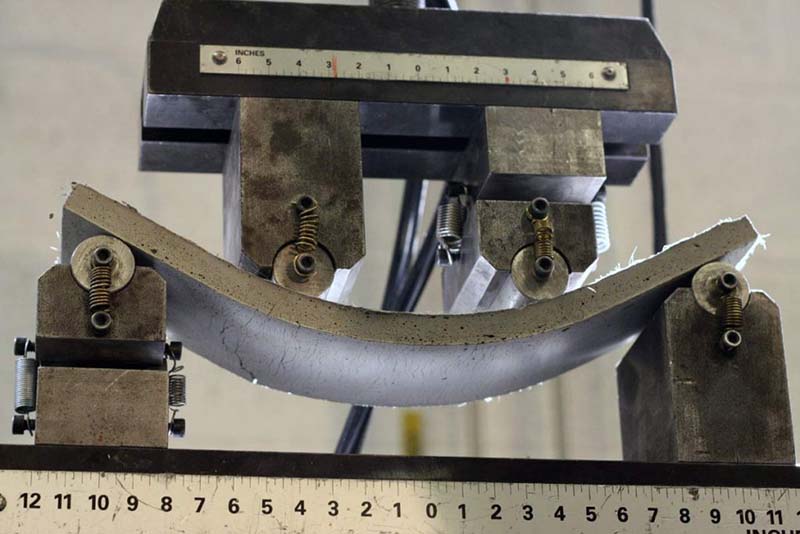
Like UHPC, ECC is not a fixed material design. The design of ECC uses micromechanics and fracture mechanics theory to achieve large tensile ductility. The defining characteristic of ECC is its strain-hardening behavior. It can reach tensile strains of 2 to 8% with crack widths staying below 60 micrometers. This means ECC can absorb significant energy and undergo large deformations without brittle failure, making it extremely valuable in seismically active areas and crack-critical structures.
ECC shares similarities with both GFRC and UHPC: fine aggregates, cement and pozzolan blends, low water-to-cement ratios, and high fiber loading. ECC often uses PVA fibers, though it can use other fiber types. Compressive strength ranges from 2,900 psi to 13,050 psi (20 MPa to 90 MPa), with flexural strengths of 1,450 psi to 2,175 psi (10 to 15 MPa).
For more about ECC, see this article about ECC.
UHPC vs. GFRC vs. ECC: Quick Comparison
| Property | UHPC | GFRC | ECC |
|---|---|---|---|
| Compressive Strength | 17,000 – 29,000 psi | Varies (not primary target) | 2,900 – 13,050 psi |
| Flexural Strength | Up to 2,900 psi | High (primary design target) | 1,450 – 2,175 psi |
| Typical Fibers | Metallic (structural) or PVA (architectural) | Alkali-resistant glass | PVA (most common) |
| Key Advantage | Overall mechanical performance and durability | Lightweight, thin-section fabrication, simpler mix design | Ductility, crack control, energy absorption |
| Ease of Use | Demands precise particle packing and low w/c ratio | Most forgiving – tolerant of ingredient variations | Requires careful micromechanical design |
| Curing | Moist curing or steam curing | Air cures with polymer (demold at 24 hrs) | Varies by formulation |
| Best For | Structural elements, infrastructure, architectural facades | Countertops, panels, furniture, decorative elements | Seismic reinforcement, crack-critical structures |
Which Material Should You Use for Decorative Concrete?
If you’re making countertops, furniture, sinks, fire features, architectural panels, or other decorative elements, GFRC is almost certainly your best starting point. It gives you excellent flexural strength, light weight, practical fabrication, and a more forgiving mix design. It is also easier to source materials for and simpler to cure.
If you genuinely need compressive strengths above 17,000 psi for a structural or specialized application, then a true UHPC formulation is appropriate. However, understand that it demands more precision in mix design, material sourcing, and curing.
ECC is specialized for applications where extreme ductility and crack control are critical, such as seismic reinforcement.
Most makers are searching for “UHPC” because they want to make beautiful, strong, lightweight concrete pieces. GFRC is the material that will actually get you there, and the engineering knowledge you build along the way applies to everything else.
Learn the Engineering Behind High-Performance Concrete
At the Concrete Countertop Institute, we’ve trained thousands of concrete countertop makers – from first-time DIYers to professional fabricators building businesses. Our training focuses on GFRC fabrication because it’s the material most relevant to decorative concrete work. The mix design principles, material science, and casting techniques you learn form a foundation for working with any high-performance cementitious material.
Rather than being locked into a premix bag or chasing a single recipe, you’ll understand why mixes work the way they do. That gives you the ability to design, adjust, and troubleshoot for any project – and the confidence to know your finished work will perform.
Explore our free GFRC training →
Learn about our hands-on workshops →